Visibility is a basic requirement of safe maritime operations. Vessels operate continuously through darkness, adverse weather, and emergency blackouts where primary lighting fails. In these conditions, crew and rescuers can struggle to find equipment, exits and hazards.
Reflective tape is a practical, low-cost way to improve visibility. It makes marked surfaces easier to see when a light source falls on them, which supports routine safety and emergency response. Its value still depends on choosing the right product, installing it correctly and inspecting it regularly. Bian Soon Trading (BST) has supplied the marine industry from Singapore since 1980 and this guide covers what crews and buyers should know.
Working on a ship after dark comes with extra challenges. Darkness and poor weather limit what the crew can see, and tasks such as mooring, cargo handling and watchkeeping rounds often take place under patchy lighting. Fog, heavy rain, sea spray and storms can make edges, equipment and fellow crew hard to pick out, which raises the risk of slips, trips and missteps on deck.
The risk rises further when lighting fails. A blackout or electrical fault can leave both main and emergency lighting unavailable at the worst moment, just when crew may need to find exits, life-saving appliances and muster stations quickly and under stress. When critical areas and equipment are easy to identify, crew can act faster and with greater confidence.
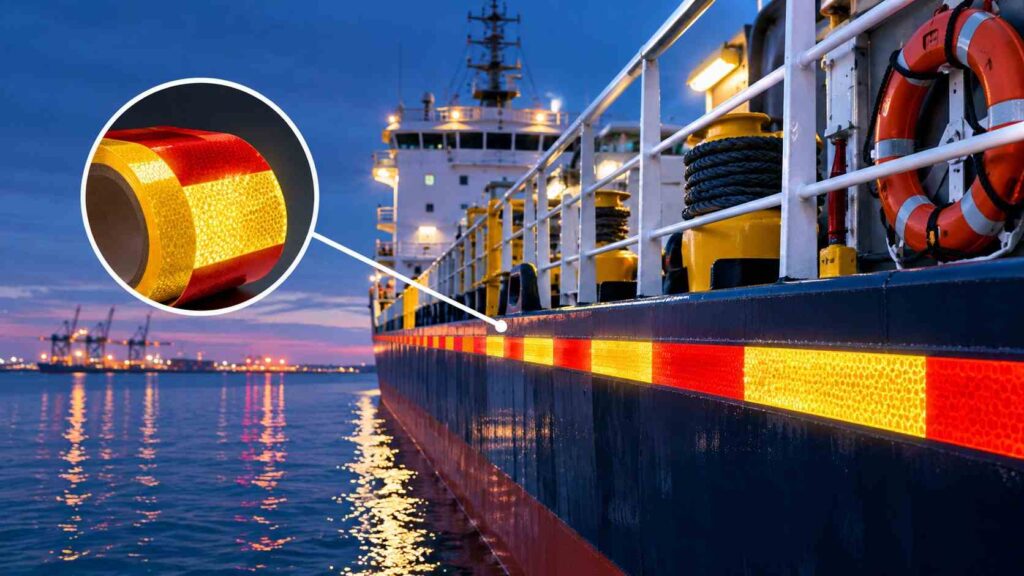
Reflective tape is made with special materials that bounce light right back using built-in glass beads and prisms. In this case, instead of dispersing the reflected light, the reflective materials send back the light to its source. The holder of the searchlight/torch will see a reflection from it.
This is what makes it different from regular coloured tapes.
| Feature | Ordinary coloured tape | Retroreflective tape |
|---|---|---|
| Visibility in darkness | Poor | Strong when lit by a light source |
| Light behaviour | Absorbs or scatters light | Returns light towards the source |
| Visible from distance | Limited | Greater range, depending on grade |
| Suitability for safety marking | Basic | Designed for conspicuity |
Visibility on board depends on more than fixed lighting, which can be blocked, damaged or simply absent in some areas. Retroreflective materials work differently because they return light from any nearby source back towards the observer.
On board, retroreflective markings improve safety in several ways:
Because the tape responds to light rather than needing its own power, it continues to work when other systems fail.
Reflective tape is applied wherever people or equipment must be seen quickly in poor light, from life-saving appliances to everyday walkways and access points across the vessel and offshore structures.
Common marine and offshore applications include:
For routine conspicuity and hazard marking, see BST’s Diamond Grade Reflective Tape with Arrow range, described below.
In an evacuation, seconds matter. Reflective markings help crew locate life-saving equipment quickly and give rescuers a visible target during nighttime search-and-rescue operations. They also complement emergency lighting by providing visibility that does not depend on a power source.
It is important to be clear about limits. The tape is an additional visibility aid. It does not replace required life-saving appliances, lighting or alarms.
When illuminated by a searchlight or another vessel’s lights, quality retroreflective material returns a bright signal even through spray and haze. Night operations, such as cargo handling, mooring and watchkeeping rounds, benefit from clearly marked edges and routes.
Material quality matters here. Poorly made tape can fade, lose brightness or peel, which defeats its purpose when it is needed most.
Ships expose materials to saltwater, moisture, UV radiation and constant temperature change. Ordinary tape can degrade quickly in these conditions. Marine applications therefore call for products with:
Some applications, particularly life-saving appliances, are governed by SOLAS and IMO performance requirements. Where a product must meet a standard, confirm that the specific product carries the relevant approval before purchase. Certification should never be assumed from the product name alone.
The right choice depends on where and how the tape will be used. A product suited to general deck marking may not meet the demands of life-saving equipment, so compare the factors below against your vessel’s requirements before ordering.
| Factor | What to consider |
|---|---|
| Application | General marking, hazard identification or regulated life-saving equipment |
| Reflectivity | The brightness and viewing distance required |
| Surface type | Smooth metal, painted steel, textured or flexible surfaces |
| Adhesive | Performance on wet, salty or oily surfaces |
| Environment | Exposed deck, sheltered area or offshore platform |
| Dimensions | Width and roll length suited to the marking task |
| Compliance | SOLAS or class requirements, where applicable |
| Specifications | Manufacturer data and recommendations |
BST supplies Diamond Grade Reflective Tape with Arrow (SKU: DGRTA), which uses prismatic lens technology formed in a transparent synthetic resin. It is engineered for strong brightness and visibility, even at wide entrance angles.
| Specification | Detail |
|---|---|
| Model / SKU | Diamond Grade Reflective Tape with Arrow / DGRTA |
| Technology | Micro-prismatic lens retroreflectors |
| Visibility | Reflective by day and by night |
| Backing | Pressure-sensitive adhesive |
| Size | 50 mm x 10 m roll |
| Colours | Yellow/black, yellow/red, fluorescent yellow/black, white/red |
Suitable uses include marking exits, doorways, borders and docks where clear daytime and night-time conspicuity is needed. Please contact our team to confirm suitability for your vessel or for any regulated equipment.
Markings only help if they remain in good condition. Build them into routine safety inspections:
Poor visibility is a real hazard at sea, and clear markings make vessels and safety equipment easier to identify in darkness and bad weather. Reflective tape is a simple, cost-effective addition to a wider safety system, provided it is suited to the application, correctly installed and regularly checked.
Vessel operators should select marine-grade products according to their application and requirements. To discuss BST’s marine reflective range or request a quotation, contact us at enquiry@bst.com.sg or call (+65) 6294 8071.